Syrenis named a Niche Player in the 2026 Gartner® Magic Quadrant™ for Privacy UX. Read the report

Data protection

The 7 data protection principles of the UK GDPR, explained

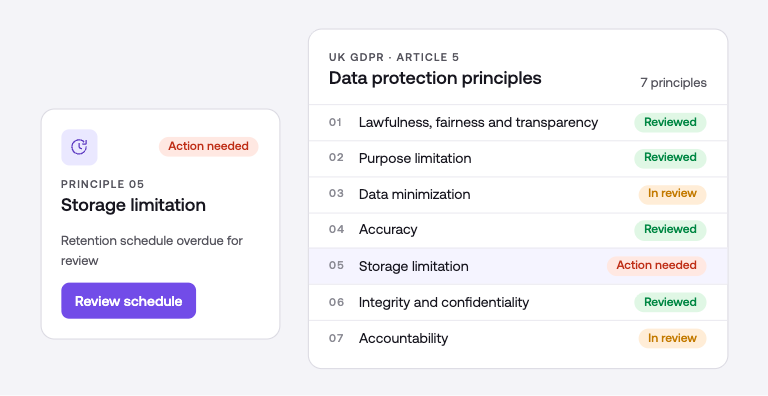
The UK GDPR has seven data protection principles, set out in Article 5: lawfulness, fairness and transparency; purpose limitation; data minimization; accuracy; storage limitation; integrity and confidentiality (security); and accountability. Every other rule in UK data protection law builds on them, and breaking one falls in the highest tier of fines, up to £17.5 million or 4% of worldwide annual turnover.

The ICO calls them the spirit of the law rather than a set of hard and fast rules. That’s a mixed blessing. They’re short enough to memorize, and broad enough that you can’t comply with them by ticking boxes. This page takes each one in turn, covers the one that changed in 2026 and shows what each looks like in a real program. For the law as a whole, start with our guide to the UK GDPR.

The seven principles at a glance

Principle In one line Where it is
Lawfulness, fairness and transparency Have a lawful basis, use data in ways people would expect, and tell them what you’re doing Article 5(1)(a)
Purpose limitation Decide why you’re collecting data, say so, and only reuse it for compatible purposes Article 5(1)(b)
Data minimization Collect and keep only what you need for those purposes Article 5(1)(c)
Accuracy Keep data correct and, where it matters, up to date Article 5(1)(d)
Storage limitation Don’t keep identifiable data longer than you need it Article 5(1)(e)
Integrity and confidentiality (security) Protect data against misuse, loss and damage Article 5(1)(f)
Accountability Take responsibility, and be able to prove you comply with the other six Article 5(2)

The wording comes from Article 5 of the UK GDPR. The first six are about how you handle data. The seventh is about whether you can show it.

1. Lawfulness, fairness and transparency

Three ideas in one principle, and you need all three. The ICO is clear that processing which is lawful but unfair, or fair but hidden, still breaks it.

Lawful means you have one of the seven lawful bases for each purpose: consent, contract, legal obligation, vital interests, public task, legitimate interests or, since February 5, 2026, recognized legitimate interests. Special category data needs an extra condition. It also means not breaking other laws in the process, such as a duty of confidence or a contract.

Fair means using data in ways people would reasonably expect, without unjustified harm. The ICO’s test is whether you should use the data, not just whether you can. Misleading people when you collect their data is almost never fair, and you need to take more care with people you know are vulnerable.

Transparent means being clear, open and honest from the start about who you are, why you want the data and what you’ll do with it. Articles 13 and 14 set out what your privacy information has to include.

The cost of getting this wrong is real. In 2023, the ICO fined TikTok £12.7 million for processing the data of children under 13 without parental consent and failing to explain clearly how it used people’s data.

How Syrenis supports it: consent management keeps one source of truth for each person’s consent across your systems, so you can prove what they agreed to, and a privacy notice manager keeps notice versions, approvals and publication history so you can show what people were told, and when.

2. Purpose limitation

You have to collect data for “specified, explicit and legitimate purposes” and not reuse it in ways that are incompatible with them. In practice, that means deciding your purposes from the start, recording them in your records of processing, stating them in your privacy information and reviewing them so you don’t drift into new uses without noticing.

What changed in 2026

This is the one principle the Data (Use and Access) Act 2025 reshaped. A new Article 8A, in force since February 5, 2026, sets out when reusing data for a new purpose is compatible with the original one.

  • The test. Weigh the link between the purposes, the context you collected the data in, the nature of the data, the possible consequences for people and the safeguards you have, such as encryption or pseudonymization.
  • Automatically compatible. Reuse counts as compatible if the person consents to the new purpose, if it’s for research, archiving or statistics with safeguards, if it’s to comply with the principles, if it meets one of the nine conditions in Annex 2, such as crime, emergencies, safeguarding, taxation and legal obligations, or if it’s needed to safeguard certain public interest objectives and authorized by law.
  • Stricter rules for consent. If you collected the data on the basis of consent, you can usually only reuse it for a new purpose with fresh consent or to comply with the principles. An Annex 2 condition or a public interest route only works if you can’t reasonably be expected to ask again.

Compatibility doesn’t give you a lawful basis on its own. You still need one for the new purpose. The ICO published updated guidance on reuse on March 23, 2026. For the EU version of the rule, see purpose limitation in the GDPR.

How Syrenis supports it: the platform’s tracker inventory is categorized by purpose, and a preference center lets customers see and control how their data is used, with every choice kept in sync across your systems.

3. Data minimization

Personal data has to be “adequate, relevant and limited to what is necessary.” That cuts both ways. The ICO says you shouldn’t collect data on the off-chance it might be useful, but you also shouldn’t hold so little that you make poor decisions about people.

Three habits make the difference:

  • Collect only what each purpose needs, and be able to say why you need each field.
  • Review what you hold periodically, and delete what you no longer need.
  • Check what your websites and apps collect without anyone asking. Third-party tags can collect more than you intended.

Our guide to the key principles of data minimization goes further.

How Syrenis supports it: progressive profiling gathers preference data in context over time, starting with what’s essential rather than a long form up front. A website audit shows which cookies, pixels and trackers each property sets.

4. Accuracy

Data has to be accurate and, where necessary, kept up to date, and you must take every reasonable step to correct or erase inaccurate data without delay. The ICO’s guidance adds some useful detail:

  • Record your sources. The more a piece of data matters, the more effort you should put into checking it.
  • Mistakes and opinions are allowed, if they’re labeled. A record of a mistake can stay if it’s clearly marked as one. An opinion isn’t inaccurate just because someone disagrees with it, but you should record whose opinion it is.
  • Take challenges seriously. Correct or erase inaccurate data promptly, and note what you decided and why. People have a right to rectification.

How Syrenis supports it: a preference center lets people review and update their own preferences, and the customer service portal lets your teams update records consistently across every system, with an audit trail of each change. Identity consent links consent to known people, not just browsers.

5. Storage limitation

You can’t keep personal data in a form that identifies people for longer than you need it. The UK GDPR doesn’t set retention periods. You set them, and you have to be able to justify them.

  • Write a retention policy. Set standard periods where you can, and document why.
  • Review and act. At the end of each period, erase the data or anonymize it so it no longer identifies anyone. Pseudonymized data usually still counts as personal data.
  • Don’t forget the copies. Taking data offline doesn’t take it out of scope. Backups count where deletion is appropriate.
  • Know the exception. You can keep data longer for archiving in the public interest, research or statistics, with appropriate safeguards, but you can’t then use it to make decisions about individuals.

6. Integrity and confidentiality (security)

You have to protect personal data against unauthorized or unlawful processing, and against accidental loss, destruction or damage. Article 32 adds the detail, and it’s risk-based: the measures have to match the risk, taking account of cost, the state of the art and what you’re doing with the data.

The ICO’s guidance boils down to four things:

  • Cover confidentiality, integrity and availability. Security isn’t only about keeping data secret. It also has to stay correct and be there when you need it.
  • Plan for incidents. Systems need to be resilient, and you need to be able to restore access to data in a timely way after an incident.
  • Test regularly. Vulnerability scans and penetration tests, with the results documented and acted on.
  • Check your processors. Use processors that give sufficient guarantees about security, and put the requirements in the contract.

Encryption and pseudonymization are named as examples of appropriate measures rather than strict requirements, though the ICO recommends encryption for storing personal data and sending it over the internet. If a breach does happen, you have 72 hours to report it to the ICO where it’s likely to put people at risk.

Some of the ICO’s largest fines have been for security failures. In October 2025, the ICO fined Capita £14 million after a cyber attack exposed the data of 6.6 million people.

How Syrenis supports it: the platform is built with security controls including SOC 2 alignment and role-based governance controls, and identity data is protected through encryption and access controls.

7. Accountability

“The controller shall be responsible for, and be able to demonstrate compliance with” the other six. The second half is the one regulators test. Good intentions without evidence don’t count.

What evidence looks like in practice:

  • Records of processing. What you hold, why, where and for how long. See what is a RoPA.
  • Impact assessments. A data protection impact assessment before any processing that’s likely to result in a high risk. See our DPIA guide.
  • A data protection officer, if you’re a public authority or your core activities involve large-scale monitoring or sensitive data.
  • Data protection by design and default, including, since February 5, 2026, taking account of children’s higher protection matters for online services likely to be accessed by children.
  • Processes for people’s rights, including access requests and, since June 19, 2026, complaints, which you must acknowledge within 30 days.
  • Contracts, policies and training that make the rest happen.

How Syrenis supports it: immutable audit records of every consent capture, update and withdrawal, version-controlled policies with rollback, and a risk portal that brings processing activity, risks and evidence into one place. The Virtual DPO gives privacy teams on-demand regulatory guidance.

Breaking a principle: what it costs

The Data Protection Act 2018 sets the higher maximum fine at £17.5 million or 4% of total worldwide annual turnover, whichever is higher, and the principles sit in that tier. Fines are only one tool. The ICO can also issue reprimands, enforcement notices that order you to change how you process data, and orders to stop processing altogether.

UK GDPR principles vs the Data Protection Act principles

Searches for “data protection act principles” usually mean one of two things.

The Data Protection Act 2018. For most organizations, the principles that apply are the UK GDPR’s seven. The Act sits alongside the UK GDPR, and its own six principles in Part 3 only apply to law enforcement processing by competent authorities, such as the police. They cover lawfulness and fairness, purpose limitation, adequacy and minimization, accuracy, storage limitation and security. The intelligence services have a separate set in Part 4.

The Data Protection Act 1998. The old Act had eight principles. It was repealed on May 25, 2018, but plenty of training material still teaches them. Here’s how they map across:

Data Protection Act 1998 (repealed) UK GDPR today
1. Processed fairly and lawfully Lawfulness, fairness and transparency
2. Obtained for specified and lawful purposes Purpose limitation
3. Adequate, relevant and not excessive Data minimization
4. Accurate and, where necessary, up to date Accuracy
5. Not kept longer than necessary Storage limitation
6. Processed in line with people’s rights No longer a principle. Individual rights have their own chapter
7. Appropriate technical and organizational measures Integrity and confidentiality (security)
8. Not transferred outside the EEA without adequate protection No longer a principle. International transfers have their own chapter
No equivalent Accountability

The 1998 wording shows the biggest shift. Accountability didn’t exist as a principle before 2018. Now it’s the one that asks you to prove everything else.

How Syrenis maps to the principles

Principle Where Syrenis helps
Lawfulness, fairness and transparency Consent management, cookie consent management, privacy notice manager
Purpose limitation Preference center, tracker inventory by purpose
Data minimization Progressive profiling, website audit
Accuracy Customer service portal, identity consent
Integrity and confidentiality Platform security controls, encryption and access controls
Accountability Immutable audit records, risk portal, data subject rights, Virtual DPO

For other laws, see consent management by regulation. Or book a demo to see how consent, preferences and evidence come together in one platform.

Frequently asked questions

What are the 7 principles of the UK GDPR?

Lawfulness, fairness and transparency; purpose limitation; data minimization; accuracy; storage limitation; integrity and confidentiality (security); and accountability. They’re set out in Article 5 of the UK GDPR.

Are the UK GDPR principles the same as the EU GDPR principles?

The seven principles are the same, with the same Article 5 wording. The rules around them have started to differ. Since February 5, 2026, the UK has its own test for when reusing data for a new purpose is compatible, in Article 8A, and a new lawful basis for recognized legitimate interests.

What are the 8 principles of the Data Protection Act?

Those are the principles of the Data Protection Act 1998, which was repealed in 2018. The UK GDPR replaced them with seven. Two of the old eight, people’s rights and international transfers, became separate chapters, and accountability was added.

Does the Data Protection Act 2018 have its own principles?

Yes, but only for law enforcement and the intelligence services. Part 3 of the Act has six principles for law enforcement processing by competent authorities. Everyone else follows the UK GDPR’s seven.

Which data protection principle is most important?

All seven apply at once, and breaking any of them can draw the highest tier of fine. Accountability is the one that ties them together, because it requires you to be able to prove you comply with the rest.

Do the data protection principles apply to small businesses?

Yes. They apply to every organization that processes personal data under the UK GDPR. Small organizations with fewer than 250 staff are exempt from some record-keeping duties, but not from the principles.

How do the principles relate to consent?

Consent is one of the seven lawful bases under the first principle. It also changes how purpose limitation works: if you collected data on the basis of consent, you usually need fresh consent before you reuse it for something new.

What happens if you break a data protection principle?

The ICO can fine up to £17.5 million or 4% of total worldwide annual turnover, whichever is higher. It can also issue reprimands and enforcement notices, or order you to stop processing.