





See how Syrenis helps simplify compliance, build trust, and gain greater control over customer data. Book a Demo

Syrenis vs OneTrust

OneTrust Alternatives and Competitors

The main OneTrust alternatives are TrustArc, BigID, Securiti, Osano, Ketch, Transcend, Usercentrics, Didomi and Syrenis. Most buyers leave OneTrust for one of three reasons: what it costs, how long it takes to roll out, or how much configuration work it takes to match the way the business actually runs.

350+ Integrations

View all

Why enterprises choose Syrenis over OneTrust

We're raising the standard in consent and preference management.

Consent specialists since 2000

Syrenis has done one thing for twenty-five years. That focus is why consent and preferences behave like infrastructure here rather than like a module someone added to a compliance suite.

Built around your stack, not the other way round

Consent models, preference channels and data structures are configured to match how your business already runs, so you don’t restructure systems to fit the tool.

Making consent data usable

Consent data that sits in one system is a compliance record. Consent data that reaches every system is an asset your marketing and product teams can actually act on.

Why teams look for alternatives to OneTrust

Ask around and the same three reasons come up first, ahead of anything technical.

Cost. Suite pricing bundles modules you’ll never open, and the bill grows with the platform rather than with your consent volume. Our own pricing works differently.

Time to value. Enterprise rollouts run long. Teams budget a quarter and lose two.

Configuration weight. Getting a suite to match how your business works takes specialist effort, and it takes it again every time the business changes.

The architectural reasons show up second, once a program is running:

  • Consent is hard to operationalize across CRM and CDP platforms
  • Complex consent models don’t fit the available structures
  • Customer preferences end up fragmented across systems
  • Consent changes take too long to propagate
  • Managing consent across multiple brands or jurisdictions gets unwieldy
  • A specialist CMP starts looking better than a governance suite with a consent module
Competitors

OneTrust competitors

OneTrust competes in more than one market at once, so “who are OneTrust’s competitors” has a different answer depending on what you’re trying to fix. Most comparison articles hand you a binary: are you buying consent management, meaning cookie banners, or a full GRC and data mapping suite? Plenty of enterprises need neither. If your banner works and your compliance program is already staffed, but consent is captured in one system and needed in eight, you don’t have a banner problem or a governance problem. You have a distribution problem, and a bigger suite doesn’t fix it.

Enterprise governance and compliance platforms

The direct swap if what you want is a suite.

TrustArc. The closest like-for-like enterprise alternative. Regulatory intelligence, assurance certifications and structured workflow management, with a consultancy heritage behind it.

BigID. Data-centric. Deep discovery, automated classification and machine learning applied to privacy governance, rather than process workflows first.

Securiti. Privacy, data security and AI governance consolidated with one vendor. Aimed at organizations trying to reduce the number of data-risk tools they run.

Comparison

Syrenis vs OneTrust, side by side

Syrenis is an enterprise consent and preference management platform built for complex, regulated organizations that need consent to work across every system, channel and jurisdiction. OneTrust is a broad governance platform with a consent module.

Positioning +

Enterprise consent and preference management

Built for consent & preferences

Broad governance platform

Privacy, AI governance, risk, and compliance

CMP focus +

Deep CMP focus

Core product, not a feature

Broad CMP

One part of a larger platform

Enterprise fit +

Built for complex, regulated environments

Where consent spans many systems

Built for consolidation

For organizations bringing several governance functions to one vendor

Integrations +

API-first

Across all systems

Set platform integrations

Pre-built within ecosystem

Consent data +

Single source of truth

Synced across domains, devices and identities

Module-level records

Synchronized through platform connectors

Preferences +

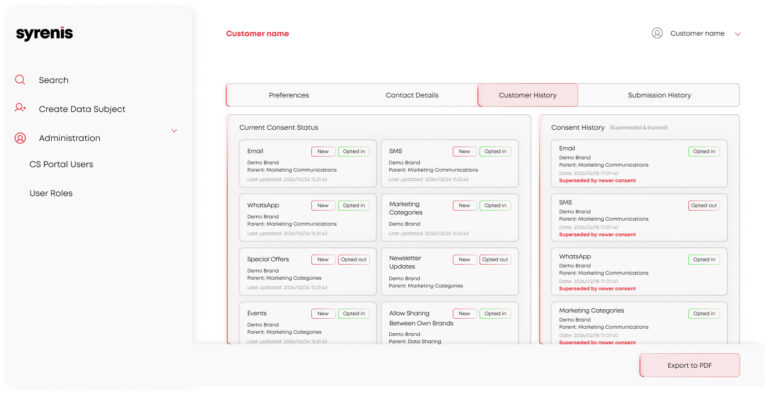
Centralized preferences

With self-service updates, preference centers, and portals

Portal-based

Part of a wider suite of services

Best-fit buyer +

Built for depth and control

Aligning privacy, marketing, and data teams

Built for breadth

For governance-led organizations

Switching

Why teams switch from OneTrust to Syrenis

OneTrust built consent as a module inside a governance suite. Syrenis built it as a real-time data layer. Teams switch when consent outgrows the website and has to behave like infrastructure: propagating into CRM, CDP, analytics and service tooling as it changes, surviving identity merges, and giving privacy and marketing the same signal to work from. That’s the gap this platform closes.

Complex environments and fragmented systems

A consent module can capture and report. Running consent across a real stack is a different job. When consent and preferences carry commercial and regulatory weight, you need one operating model behind them: a single source of truth, consistent enforcement across systems, identities, channels and jurisdictions, and an audit trail that holds up end to end. That’s what Syrenis is built for.

Switching from OneTrust

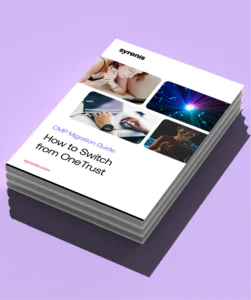
Download our practical migration guide covering governance, implementation, integrations, consent enforcement, and rollout planning.

Built for enterprise privacy, marketing, and IT teams looking to reduce migration risk, maintain compliance, and ensure continuity across systems, identities, and jurisdictions.

Related Content
Platform Architecture

Supporting enterprise scale and complexity

Designed to handle complex, regulated environments, our architecture delivers the performance, resilience and flexibility required to manage consent across global systems and data flows.

Scale without limits

Cloud-native and highly resilient, our infrastructure delivers fast, reliable performance across regions. Distribute workloads globally, eliminate single points of failure, and maintain consistency, even at peak demand.

Why Syrenis

Where consent stops being a cost center

Syrenis gives privacy leaders control and visibility across complex, global environments. It unifies systems, applies preferences as they change, and gives marketing a permissioned audience it can actually use rather than a list nobody trusts.

- Scalability

Enterprise-scale consent management

Many organizations researching OneTrust alternatives need consent and preference management that can scale across regions, brands, channels, and high-volume customer environments. Syrenis delivers enterprise-grade performance without compromising compliance or operational flexibility.

Implementing Syrenis has enabled us to deliver tailored and specific content, ensuring that our clients only receive the right information based on their requirements. We have a complicated set of preference channels, which Syrenis streamlines to improve the customer experience.

Head of Compliance

Lexis Nexis

- Governance

Global compliance without fragmented workflows

Unlike traditional consent modules, Syrenis centralizes consent and preference management across systems from a single operational layer. Apply location-specific policies, maintain auditability across GDPR and CCPA frameworks, and reduce fragmented compliance workflows.

Implementing Syrenis has been a game-changer for us. The platform’s flexibility and advanced capabilities have ensured our global regulatory compliance across all channels and sites. Syrenis has truly transformed our approach to cookie management and privacy compliance.

Service Delivery Manager

Media

- Efficiency

Real-time consent orchestration across every system

Organizations switching from OneTrust often need consent signals to update instantly across CRM, CDP, analytics, customer service, and activation platforms. Syrenis synchronizes customer preferences in real time so every team works from the same trusted data.

The capabilities of Syrenis are unmatched: its flexibility, scalability, and granularity are unique. I’m confident that this technology solves both our current challenges and into the next 5 years and beyond. This is an important step forward in managing our complex relationships compliantly.

Head of Technical Privacy & Governance

Retail

Support

Frequently asked questions

What are the best OneTrust alternatives?

The most commonly evaluated OneTrust alternatives are TrustArc, BigID, Securiti, Osano, Ketch, Transcend, Usercentrics, Didomi and Syrenis. They fall into three groups. Enterprise governance suites, where TrustArc is the closest like-for-like swap and BigID and Securiti come at it from data discovery and data security. Lightweight mid-market tools, where Osano, Ketch and Transcend deploy fast and configure less. And enterprise consent and preference platforms, where Didomi and Syrenis run consent across the whole estate rather than at the point of collection. Which group fits depends on whether your problem is proving compliance, putting a banner up, or getting consent from the system that captured it into the eight systems that need it.

Why do companies switch from OneTrust?

Cost, time to value and configuration weight come up first. Suite pricing bundles modules you never open, enterprise rollouts run longer than budgeted, and matching the platform to how the business actually works takes specialist effort every time the business changes. The architectural reasons follow once a program is running: consent is hard to operationalize across CRM and CDP, complex consent models don’t fit the available structures, and changes take too long to reach the systems that need them.

What is the difference between TrustArc and OneTrust?

Both are enterprise governance suites and they compete directly. TrustArc leans on regulatory intelligence, assurance certifications and structured workflow management, with a consultancy heritage behind it. OneTrust is broader, covering privacy, AI governance, risk and compliance in one platform. If you want a like-for-like replacement for OneTrust rather than a change of approach, TrustArc is the closest one on the list.

What is the difference between OneTrust and Transcend?

OneTrust is a broad governance suite bought by teams consolidating several compliance functions with one vendor. Transcend is developer-friendly and API-first, focused on automated data discovery and fast DSAR fulfillment, and it deploys with far less configuration. The trade is breadth against speed: OneTrust covers more ground, Transcend gets a narrower job done sooner.

Do I need a cookie consent tool or a full privacy suite?

Often neither. If proving compliance, mapping data and running assessments is the hard part, a governance suite is the right shape. If you just need a compliant banner on one domain, a mid-market tool covers it. But if your banner already works and your compliance program is already staffed, and the problem is that consent is captured in one system and needed in eight, that’s a distribution problem. A bigger suite doesn’t fix it and a simpler banner doesn’t either.

Does Syrenis replace OneTrust?

Yes. Organizations can use Syrenis as an alternative to OneTrust when they need enterprise-grade consent and preference management across multiple systems, channels, and jurisdictions. Syrenis is designed to centralize consent records, synchronize updates in real time, and provide a single source of truth for customer permissions and preferences across the wider technology stack.

Is Syrenis easier to integrate than OneTrust?

Syrenis is API-first, so consent moves between systems as records change rather than on a scheduled sync. In practice that means the consent model bends to your architecture, across multiple brands, regions, channels and identity systems, instead of your architecture bending to the tool. See the integrations directory for what’s available today.

Is OneTrust the right CMP for enterprise businesses?

It can be. If your organization is consolidating several governance functions with one vendor and consent is one of them, OneTrust is a reasonable default. It’s a weaker fit when consent has to behave like infrastructure across a complex estate, because the consent module was built to capture and report rather than to distribute. We’ve written this up in more detail in is OneTrust the right CMP for your business.

What's the difference between OneTrust and a specialist CMP?

A governance suite treats consent as one module among many, alongside data mapping, assessments and risk workflows. A specialist consent and preference platform treats it as the product: identity resolution, cross-domain handling, preference centers and real-time propagation are core rather than add-ons. The choice comes down to your operating model, which we cover in when to use OneTrust vs a specialist CMP.