Syrenis named a Niche Player in the 2026 Gartner® Magic Quadrant™ for Privacy UX. Read the report

The Data (Use and Access) Act 2025: what changed for cookies and consent

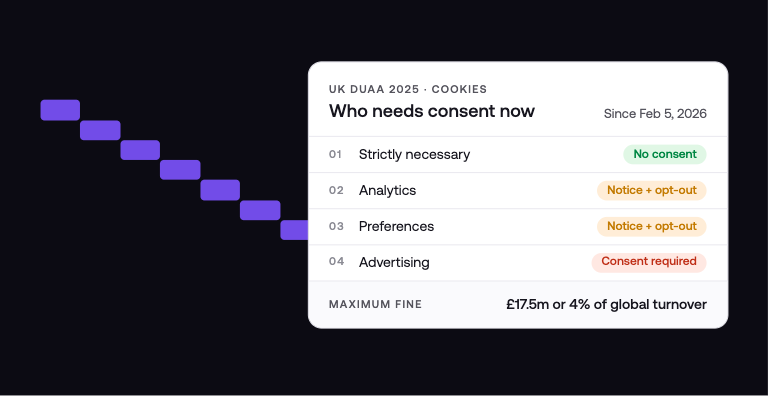
Since February 5, 2026, the Data (Use and Access) Act 2025 (DUAA) has let websites and apps use some analytics and preference cookies without asking for consent, as long as they explain them and give people a simple way to object. It also raised the maximum fine for breaking the UK cookie rules from £500,000 to £17.5 million or 4% of worldwide annual turnover, and advertising cookies still need consent.

That’s the short version. The longer one matters more, because the new exceptions are narrow, the conditions are easy to miss, and a banner that was right in 2025 can now be wrong in two directions: asking for consent the law no longer requires, or dropping consent for cookies that still need it.

The changes at a glance

Change What it means In force
Analytics exception Analytics used solely to improve your service no longer need consent, subject to four conditions February 5, 2026
Appearance and functionality exception Storage that only adapts how your website or app looks or works to a visitor’s preferences no longer needs consent February 5, 2026
Emergency assistance exception Locating a device so emergency help can reach the user no longer needs consent February 5, 2026
A wider rule Collecting or monitoring information a device sends out automatically now counts as accessing it February 5, 2026
Higher fines Cookie breaches can reach £17.5 million or 4% of worldwide annual turnover, up from £500,000 February 5, 2026
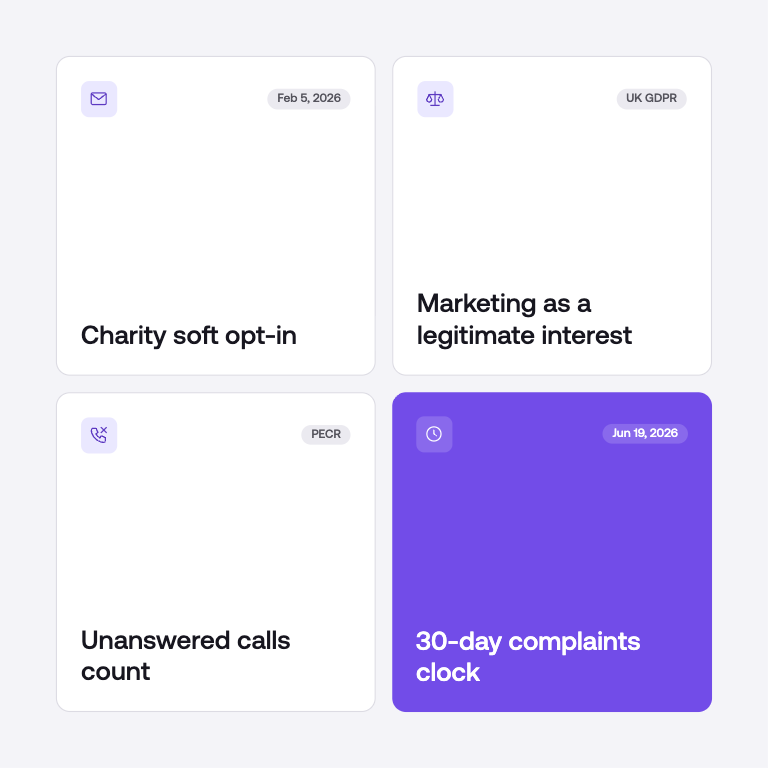
Charity soft opt-in Charities can email or text supporters about their charitable purposes without prior consent, with conditions February 5, 2026
Final ICO guidance The ICO’s guidance on storage and access technologies sets out how it reads the new exceptions April 29, 2026
Complaints duty People can complain to you directly, and you must acknowledge within 30 days June 19, 2026
New regulator structure The Information Commission replaces the Information Commissioner, still known as the ICO September 30, 2026

What the Data (Use and Access) Act is

The DUAA is a UK law that received Royal Assent on June 19, 2025. It amends the three laws that govern personal data and tracking in the UK: the UK GDPR, the Data Protection Act 2018 and the Privacy and Electronic Communications Regulations (PECR). It also covers areas well beyond privacy, such as digital verification services and smart data schemes.

It’s being switched on in stages. Most of its data protection and cookie changes took effect on February 5, 2026, under the Commencement No. 6 Regulations. The complaints duty followed on June 19, 2026, and the regulator became a corporate Information Commission on September 30, 2026. For the wider picture, including lawful bases, automated decisions and international transfers, see our guide to the UK GDPR.

The new UK cookie rules

PECR’s core rule hasn’t moved. Under regulation 6, you can’t store information on someone’s device, or access information stored there, unless they consent or an exception applies. What the DUAA changed is the list of exceptions, now set out in a new Schedule A1, and the reach of the rule itself. For the full UK rules, including how valid consent works, see UK cookie law explained.

The rule now covers what devices send out on their own

The new regulation 6 treats collecting or monitoring information that a device emits automatically as gaining access to it. That reaches past cookies to techniques that read what a browser or phone transmits by itself. It’s one more reason the ICO’s guidance covers pixels, link decoration, fingerprinting and web storage as well as cookies.

Analytics without consent: the statistical purposes exception

You can now run analytics without consent if all four conditions are met:

  1. The sole purpose is to collect statistics about how your service is used, so you can improve it.
  2. You give clear and comprehensive information about that purpose.
  3. You give people a simple, free way to object, and they haven’t used it.
  4. You don’t share what you collect with anyone except someone helping you improve the service.

The fourth condition is where most analytics setups get tested. The ICO says a third-party analytics provider can only act on your behalf, as your processor, and use the information to help you improve your service. If the provider uses the data for its own purposes, the exception doesn’t apply. Check your vendor’s terms and data-sharing settings before you switch consent off.

Three more limits from the ICO’s guidance:

  • Aggregate only. The output has to be aggregate statistics you can’t use to identify people. The exception doesn’t let you track or monitor individual visitors.
  • Not via browser settings alone. You must not rely solely on browser settings to decide whether someone objects. Offer the objection route on your own site or app.
  • Not automatically emitted data. The exception’s definition of access leaves out collecting or monitoring information the device sends out automatically, so it doesn’t stretch to that kind of measurement.

Preference cookies: the appearance and functionality exception

The second new exception covers storage or access whose sole purpose is to adapt how your website appears or functions to a visitor’s preferences, or otherwise improve its appearance or functionality. You still have to explain it and give people a simple, free way to object. The ICO’s examples include remembering a chosen language, responsive layouts, fonts and following a device’s dark mode setting.

It covers apps too. Schedule A1 defines “website” to include “a mobile application and any other platform” through which an online service is provided.

It doesn’t cover changing what someone sees based on their profile, browsing history or inferred interests. That’s personalization, and it still needs consent.

Emergency assistance

The third new exception lets a service find a device’s location when the user needs emergency help, and only for that purpose. The ICO’s examples are things like in-car emergency calls, personal safety alarms and smartwatch fall detection. Most websites won’t need it.

What still needs consent

The ICO is blunt about advertising: “online advertising purposes are not exempt from PECR’s consent requirements and never have been.” That includes ad measurement, frequency capping and fingerprinting for ads.

Group Examples
Still needs consent Advertising, retargeting and ad measurement. Cross-site or cross-device tracking. Social media pixels. Personalizing content on someone’s interests or history. Analytics that don’t meet all four conditions
Exempt if you explain it and let people object Analytics used solely to improve your service, run by you or a provider acting for you. Language, layout, font and dark mode preferences
Exempt Strictly necessary storage, such as login sessions, a checkout basket, security and fraud prevention. Storage needed only to send a communication. Locating a device for emergency help

Watch for mixed purposes. An exception only works if the technology is used solely for the exempt purpose. If one cookie or tag serves an exempt purpose and a non-exempt one, it needs consent.
Fines and enforcement

Fines and enforcement

The DUAA brought PECR under the Data Protection Act 2018’s penalty regime. For the cookie rules, the maximum is now £17.5 million or 4% of total worldwide annual turnover, whichever is higher. That’s the same as the UK GDPR’s top tier, and it applies to breaches from February 5, 2026. Earlier breaches stay under the old regime.

The ICO says it reserves fines for the most serious infringements, but cookies are firmly on its list. In December 2025 it reported that 979 of the UK’s top 1,000 websites now passed its checks. 564 of them improved after the ICO stepped in, and it issued 17 preliminary enforcement notices along the way. It checked three things: whether advertising cookies were set before people could choose, whether rejecting was as easy as accepting, and whether advertising cookies were set without consent.

What’s next: advertising without consent?

Probably not yet. The DUAA gave the government a power to add, change or remove exceptions by regulations, after consulting the regulator and with approval from both Houses of Parliament.

In May 2026, the ICO sent the government advice on lower-risk advertising, such as ads based on the content someone’s viewing rather than their past activity. Its report suggests ad delivery, frequency capping on a single service, fraud prevention, brand safety, aggregate measurement and broad contextual targeting could run without consent, with safeguards, while behavioral advertising stays consent-based. The ICO was clear that “nothing has changed at this stage.” Until the government makes regulations, advertising cookies need consent.

Consent beyond cookies: marketing, complaints and the UK GDPR

The DUAA changed more than the cookie rules. Four changes touch how you collect and use consent.

  • Charities’ soft opt-in. Since February 5, 2026, charities can send email and text marketing about their charitable purposes without prior consent to people who’ve supported them or expressed an interest, as long as they offered a simple, free opt-out when they collected the details and offer one in every message. It applies to details collected from that date, and it doesn’t cover phone calls.
  • Direct marketing as a legitimate interest. The UK GDPR now names direct marketing as an example of processing that may be necessary for legitimate interests. That’s about the lawful basis for using the data. It doesn’t replace PECR’s consent rules for marketing emails and texts.
  • Messages that never arrive still count. PECR’s definitions of a call and a communication now cover messages whether or not they reach the intended recipient, so an unanswered marketing call can still breach the rules.
  • Complaints with a clock. Since June 19, 2026, people can complain to you directly about how you’ve handled their data, and section 164A of the Data Protection Act 2018 says you must make that easy, acknowledge within 30 days and respond. A complaint about an ignored opt-out or cookie choice now has a statutory deadline, so you need the record of what that person chose, and when.

UK, EU and US cookie rules no longer line up

The UK and EU used to run near-identical cookie rules, because PECR implemented the EU’s ePrivacy Directive. They’ve split. The directive still allows only two exemptions, for sending a communication and for storage that’s strictly necessary for a service the user asked for. Analytics and preference cookies that are exempt for UK visitors can still need consent from visitors in the EU. The EU has proposed changes of its own, but they aren’t law yet.

The US works differently again, with state laws built around opting out rather than opting in. See US cookie laws and universal opt-out mechanisms.

If you’re a US company with UK visitors

The ICO says PECR has no specific rules for organizations based outside the UK, but the UK GDPR applies to the personal data your cookies collect if you offer goods or services to people in the UK or monitor their behavior. A UK company that hosts its site overseas still has to comply with PECR. The practical answer is to apply UK rules to UK visitors and let the banner change by region.

That means at least three rule sets on one site:

UK EU US (most states)
Analytics to improve the service Can be exempt, with conditions, information and a way to object Consent Generally no consent needed. Opt-out rules apply to targeted advertising and selling or sharing data
Preference cookies Can be exempt, with information and a way to object Consent, unless strictly necessary No consent needed
Advertising Consent Consent Opt-out, and in some states a browser signal you must honor

How to update your UK cookie banner

01

Audit what actually fires

Scan every site and app, before anyone clicks, so you know what sets cookies and reads device information. A website audit is the place to start.

02

Sort each technology by purpose

Strictly necessary, analytics, preferences, advertising, social or personalization. Anything with mixed purposes stays in the consent group.

03

Check your analytics provider’s role

It has to act as your processor and use the data only to help you improve your service. Review the contract and any data-sharing settings.

04

Add a way to object

For exempt analytics and preferences, give a simple, free objection option that’s as easy to find as your consent controls. Don’t rely only on browser settings.

06

Keep consent for everything else, done properly

Block non-exempt tags until consent, make rejecting as easy as accepting, default toggles to off, and treat no answer as no. See cookie banner symmetry.

07

Split the rules by region

UK visitors can get the new exceptions. EU visitors can’t. Change this centrally rather than site by site.

08

Record every choice

Keep a record of what each person saw and chose, including objections, so you can answer a complaint or a regulator.

How Syrenis helps

Updating a banner for the DUAA is rarely a single setting. Cookie consent management from Syrenis applies different rules by jurisdiction, so your UK banner can use the new exceptions while your EU banner keeps asking for consent, without hardcoding logic into every site.

  • Discovery. Site and app scanning finds the cookies, pixels and trackers each property sets, and flags new ones as teams add them.
  • Enforcement. Non-exempt scripts are held until valid consent exists, and stopped the moment someone changes their mind.
  • Proof. Every choice is recorded against the notice the person saw, ready for an audit, a complaint or a regulator’s question.
  • Beyond cookies. A preference center keeps marketing choices in sync across systems, and privacy rights workflows track requests against their deadlines.

For other laws, see consent management by regulation. Or book a demo to see UK and EU cookie rules running on the same site.

Frequently asked questions

What is the Data (Use and Access) Act 2025?

A UK law that received Royal Assent on June 19, 2025. It amends the UK GDPR, the Data Protection Act 2018 and PECR, and covers wider areas such as digital verification services. For cookies, it added new exceptions to consent and raised the maximum fine.

What does DUAA stand for?

The Data (Use and Access) Act 2025. Before it became law, it was the Data (Use and Access) Bill, often shortened to DUAB.

When did the DUAA come into force?

In stages. The main data protection and cookie changes took effect on February 5, 2026. The complaints duty followed on June 19, 2026, and the Information Commission replaced the Information Commissioner on September 30, 2026.

Do analytics cookies need consent in the UK now?

Not always. Since February 5, 2026, you don’t need consent for analytics if they’re used solely to improve your service, you explain them, you give people a simple, free way to object, and any provider only uses the data to help you. If the provider uses the data for its own purposes, or you track individual visitors, you still need consent.

Does the DUAA apply to apps?

Yes. PECR covers information stored on or read from any device, and Schedule A1 defines “website” to include a mobile application. Both the analytics and the appearance exceptions can apply to apps.

Do I still need a cookie banner?

Almost certainly. Advertising, social media and cross-site tracking still need consent. And if you rely on the new exceptions, you still have to explain them and give people a way to object, which usually lives in the same banner or preference layer.

What is the fine for breaking the UK cookie rules?

Up to £17.5 million or 4% of total worldwide annual turnover, whichever is higher, for breaches from February 5, 2026. Before that, the maximum was £500,000.

Does the DUAA change cookie rules in the EU?

No. It’s UK law. EU visitors are still covered by the ePrivacy Directive, which has only two exemptions, so analytics and preference cookies can still need consent there.

Does the DUAA apply to US companies?

The cookie rules can matter for any site with UK visitors. The ICO says PECR has no specific rules for organizations outside the UK, but the UK GDPR applies to personal data your cookies collect if you offer goods or services to people in the UK or monitor their behavior. The safe approach is to apply UK rules to UK visitors.

Fact sources

The law

The regulator and government