Syrenis named a Niche Player in the 2026 Gartner® Magic Quadrant™ for Privacy UX. Read the report

Cookie banner requirements: what US law actually requires

No federal law requires a cookie banner in the US, and most state privacy laws work on an opt-out basis, so the European-style “accept before anything loads” banner usually isn’t a legal requirement here. What is required, in California and 11 other states, is a clear way to opt out of the sale or sharing of personal information, automatic honoring of browser opt-out signals like Global Privacy Control, and an opt-out that actually stops the tracking.

That last part is where US companies are getting fined. Since March 2025, California regulators have announced settlements with Honda, Todd Snyder, Healthline, Tractor Supply and Disney, and in each case the banner, the opt-out or the signal handling didn’t do what it claimed to.

Do you need a cookie banner in the US?

Legally, a US-only business usually doesn’t need an opt-in banner. In practice, most businesses of any size run one anyway, for three reasons.

State privacy laws require a working opt-out.

California’s CCPA and the comprehensive privacy laws in most other states give consumers the right to opt out of the sale of their personal information and its use for targeted advertising. Third-party advertising cookies and pixels are one of the most common ways that sale or sharing happens. A banner, paired with a footer link, is usually the simplest place to offer the opt-out and to record it.

Some data needs opt-in consent.

Most state privacy laws require consent before you process sensitive data, such as health information or precise geolocation. Minnesota’s law, for example, requires consent to process sensitive data and allows it to be revoked at any time.

Wiretapping lawsuits target tracking technology.

Plaintiffs in California have filed thousands of claims arguing that pixels, analytics and session replay tools amount to illegal wiretapping. Consent is one of the strongest defenses, and a banner that blocks those tools until someone agrees is how you get it.

If you also have visitors in the EU or UK, the answer changes: there, you need opt-in consent before non-essential cookies are set. That’s covered further down.

What US privacy laws require from your banner

The laws don’t describe a banner. They describe how opting out has to work, and the banner is where most businesses implement it. Working from the CCPA regulations and California’s enforcement record, a compliant US setup:

Requirement What it means in practice
Offers a clear opt-out A “Do Not Sell or Share My Personal Information” link, or equivalent, that’s easy to find
Honors browser signals Treats Global Privacy Control as a valid opt-out request, automatically
Keeps choices symmetrical Opting out takes no more steps than opting in
Doesn’t demand ID No identity verification for an opt-out request
Actually stops the tracking Pixels, tags and ad tech stop sharing data, not just a database flag
Follows the person Applies the opt-out across devices and services for known account holders
Confirms the choice Shows the user their opt-out was processed
Gets consent where required Opt-in before sensitive data is processed, where state law demands it
Has vendor contracts in place Ad tech partners are bound by the terms the CCPA requires
Keeps working Is monitored, so a broken banner gets noticed in hours, not weeks

Almost every row in that table comes from a specific enforcement action. The next two sections explain where.

Global Privacy Control: the signal you’re probably already receiving

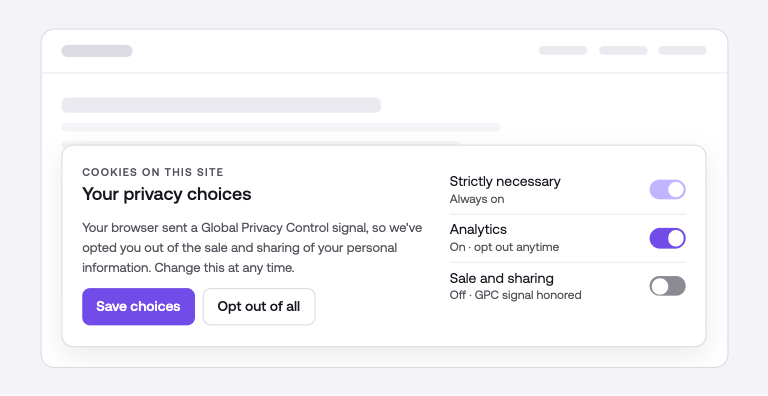
Global Privacy Control, or GPC, is a setting in a user’s browser or extension that tells every website they visit not to sell or share their personal information. It arrives automatically, before the visitor clicks anything.

Twelve states now require businesses to treat it as a valid opt-out: California, Colorado, Connecticut, Delaware, Maryland, Minnesota, Montana, Nebraska, New Hampshire, New Jersey, Oregon and Texas. Colorado was the first to make it mandatory, on July 1, 2024, and GPC is the only universal opt-out mechanism Colorado has formally recognized. Maryland’s framework works a little differently from the others, and several states with privacy laws, including Virginia, Utah and Tennessee, don’t require it at all.

The volume is about to change. California’s Opt Me Out Act, signed on October 8, 2025, requires every browser available to California residents to include an easy-to-find opt-out signal setting from January 1, 2027. Today only a handful of browsers and extensions support GPC. From next year, Chrome, Safari and Edge will all have to offer it, and the number of signals your site receives will rise sharply.

Two practical points. Honoring GPC for every visitor is simpler than switching it on and off by state, and it never breaks a state law that doesn’t require it. And if the visitor is logged in, the opt-out should apply to their account, not just that browser. Honda was cited for failing to do exactly that.

What California has fined companies for

California’s enforcement record is the clearest guide to what a US cookie banner has to get right. Since March 2025, the California Privacy Protection Agency, now branded CalPrivacy, and the Attorney General have announced these actions:

Company Announced Penalty What went wrong
Honda March 2025 $632,500 Accepting all cookies took one click and opting out took two. Opt-outs required identity verification. GPC opt-outs weren’t applied to known account holders. Ad tech contracts lacked required terms
Todd Snyder May 2025 $345,178 The cookie banner was misconfigured and consumers couldn’t use it for 40 days. Every privacy request, including opt-outs, required a photo ID. Nobody was monitoring the third-party consent tool
Healthline July 2025 $1.55 million Kept sharing data for advertising after users opted out through the banner, forms or GPC, including article titles that revealed health conditions
Tractor Supply September 2025 $1.35 million Didn’t honor opt-out preference signals, and its privacy policy hadn’t been updated since 2021
Disney February 2026 $2.75 million Opt-outs applied only to one service, and often only one device. Opt-out signals weren’t treated as valid requests

Disney’s was the largest CCPA settlement on record when it was announced. General Motors’ $12.75 million settlement in May 2026 has since overtaken it, though that case concerned the sale of vehicle data rather than cookies.

The pattern is consistent. Regulators aren’t reading privacy policies and stopping there. They’re testing whether the banner works, whether clicking “opt out” actually stops the pixels, and whether a broken consent tool gets noticed. We’ve gone through the Honda case in detail in the art and requirements of cookie banner symmetry.

Cookie banners and the CIPA lawsuit wave

The California Invasion of Privacy Act dates from 1967 and was written to stop telephone wiretapping. Plaintiffs’ firms now use it against ordinary website technology, arguing that pixels, analytics tags, session replay and chat tools amount to wiretapping under Section 631, or to illegal “pen registers” and “trap and trace devices” under Section 638.51.

The exposure comes from the damages. CIPA allows statutory damages starting at $5,000 per violation, with no need to show actual harm, and plaintiffs argue violations can be counted per visitor or per session. According to the sponsors of the reform bill, the number of these website-tracking lawsuits grew from roughly 600 to nearly 4,000 in the time it took the bill to pass, and thousands more businesses have received demand letters.

That reform is Senate Bill 690. The California Legislature passed it unanimously on August 28, 2026. If it becomes law, only the Attorney General, not private plaintiffs, will be able to bring pen register and trap and trace claims over website and app tracking, and the change will apply to pending claims filed within the previous two years. The governor has until September 30, 2026 to act, and if he doesn’t veto it, it takes effect on January 1, 2027.

It won’t end the lawsuits. SB 690 doesn’t touch Section 631, the wiretapping provision that plaintiffs also use against session replay, chat features and third-party pixels. And that’s where a cookie banner earns its place: consent is one of the strongest defenses to a Section 631 claim, and a banner that holds back session replay and third-party pixels until the visitor agrees is how you document it.

What a US cookie banner should look like

A banner built for US law looks different from a European one, and a banner built for both needs to know where the visitor is.

For US visitors:

  • A short notice explaining what you collect and why, with a link to your privacy policy
  • Accept, reject and manage options with equal weight. Honda’s two-clicks-versus-one design is the one to avoid
  • Session replay, chat tools and third-party pixels held back until the visitor agrees, to manage CIPA risk
  • A persistent “Your Privacy Choices” or “Do Not Sell or Share My Personal Information” link in the footer
  • Automatic detection of GPC, with the site confirming to the visitor that their opt-out has been honored

For EU and UK visitors, an opt-in banner that blocks everything non-essential until the visitor chooses. See the next section.

What your banner should say. Plain, specific and short. Something like this works for US traffic:

We use cookies and similar technologies to run this site, understand how it’s used and, with your permission, show you relevant ads. You can accept all, reject non-essential cookies, or choose by category. You can change your mind at any time using Your Privacy Choices at the bottom of every page.

Accept all · Reject non-essential · Manage choices

Name the purposes, give the choices equal prominence, and tell people how to come back.

If you also have visitors in the EU or UK

The rules are stricter, and they’re opt-in. Under the ePrivacy Directive in the EU and PECR in the UK, you need consent before setting any cookie that isn’t strictly necessary.

The EDPB’s Cookie Banner Taskforce set out what European regulators treat as non-compliant: no reject option on the first layer, pre-ticked boxes, reject options hidden as text links, colors and contrast that steer people toward accepting, and no easy way to withdraw consent. We’ve covered those in detail in 8 most common cookie banner mistakes.

The UK relaxed its rules slightly on February 5, 2026. Some first-party analytics and cookies that remember a stated preference no longer need opt-in consent, but you still have to offer users a way to object. The same change raised the UK’s maximum fine for cookie breaches to £17.5 million or 4% of global turnover.

The practical answer for a US company with international traffic is a banner that detects location: opt-in for European visitors, opt-out with GPC for US visitors, and one consent record behind both. More on the underlying law in our ePrivacy Directive and GDPR overviews.

Where US cookie banners break

The rules are the manageable part. Three failures come up again and again, and the enforcement record shows all three.

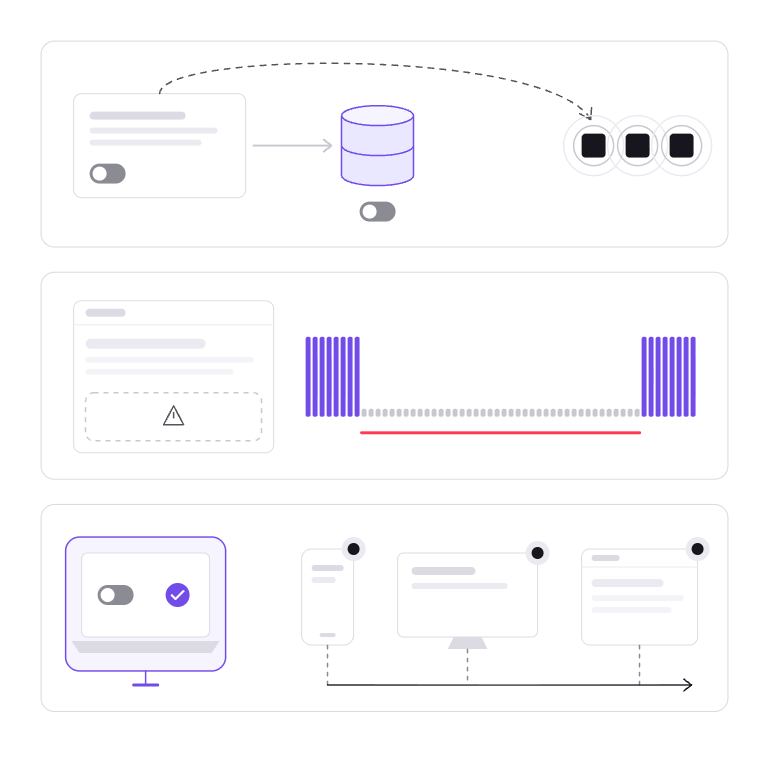
The opt-out changes a setting but not the tracking. A visitor clicks “opt out”, a flag flips in a database, and the pixels keep firing. That’s the Healthline pattern, and many organizations only discover it when they test.

The banner breaks and nobody notices. A tag manager update, a new site template or a vendor change stops the banner from loading. Todd Snyder’s was down for 40 days. Without monitoring, there’s nothing to tell you.

The opt-out stops at one door. A visitor opts out on your website, then keeps being tracked in your app, on another brand’s site or on their TV. That’s the Disney case, and it’s the most common gap on larger estates.

None of these show up in a screenshot of your banner. They show up when a regulator tests it.

Where Syrenis fits

A cookie banner is the visible part. What decides whether it holds up is what sits behind it.

Cookie management covers the banner itself: accept, reject and customize options with equal weight, non-essential tracking blocked until the visitor chooses, and every decision stored with the notice version, timestamp and jurisdiction in a form that can’t be edited afterwards. That record is the first thing a regulator asks for.

The website audit keeps a live inventory of the cookies, tags and pixels on your sites by purpose, vendor and risk, and flags new ones as they appear. That’s how you find the tracking your banner doesn’t know about before a regulator or a plaintiff does.

If you want your banner to perform as well as comply, our cookie consent rate optimization checklist runs through 20 specific points, and how to improve cookie consent rates covers the balance between compliance and user experience. For the underlying law, see our CCPA overview.

If you want to see how your own banner holds up, book a demo and we’ll test it with you.

This content is provided for general information only and should not be considered legal advice.

FAQs

Is it illegal to not have a cookie banner?

In the US, usually not. No federal law requires one, and most state laws are opt-out rather than opt-in. But California and 11 other states require a working opt-out and automatic honoring of Global Privacy Control, and a banner is the usual way to deliver both. If you have visitors in the EU or UK, you generally do need opt-in consent before setting non-essential cookies.

Which websites have cookie banners?

Most commercial websites with US or European visitors, because almost every site uses analytics, advertising or embedded third-party tools. In the US, a banner is how many sites offer and record opt-outs. In Europe, it’s how they collect the consent the law requires.

What should my cookie banner say?

Say what you collect and why in plain language, name the purposes, and give accept, reject and manage options equal prominence. Tell visitors how to change their choice later, usually through a “Your Privacy Choices” link in the footer.

How do I create a cookie banner?

Start with an inventory of every cookie, tag and pixel on your site, because you can’t control what you haven’t found. Then use a consent management platform to show the banner, block tracking until the visitor chooses, honor Global Privacy Control, and record every decision. Test it regularly, since a broken banner is an enforcement risk in its own right.

Are cookie banners legally required?

In the EU and UK, consent for non-essential cookies is required, and a banner is the usual way to collect it. In the US, a banner isn’t required as such, but a clear opt-out and automatic honoring of browser opt-out signals are required in 12 states, including California.

What are the legal requirements for a cookie banner?

For US visitors: a clear opt-out from the sale or sharing of personal information, automatic honoring of Global Privacy Control in states that require it, no more steps to opt out than to opt in, no identity checks for opt-outs, and an opt-out that actually stops the tracking. For EU and UK visitors: prior opt-in consent, with reject as easy as accept.

Is the CCPA still in effect?

Yes. The California Consumer Privacy Act took effect in 2020 and was expanded by the California Privacy Rights Act. It’s enforced by the California Attorney General and the California Privacy Protection Agency, now branded CalPrivacy, and enforcement has increased sharply since 2025.

Does the CCPA require cookie consent?

Not opt-in consent for most cookies. The CCPA requires businesses to let consumers opt out of the sale or sharing of their personal information, which includes most third-party advertising cookies and pixels, and to honor opt-out preference signals like Global Privacy Control. Opt-in consent is required in specific cases, such as selling the personal information of consumers under 16.

Do I have to honor Global Privacy Control?

In 12 states, yes: California, Colorado, Connecticut, Delaware, Maryland, Minnesota, Montana, Nebraska, New Hampshire, New Jersey, Oregon and Texas. Honoring it for every visitor is the simplest approach. From January 1, 2027, California requires all browsers to offer the signal, so expect far more of it.