Syrenis named a Niche Player in the 2026 Gartner® Magic Quadrant™ for Privacy UX. Read the report

Privacy roles

What is a data protection officer, and do US companies need one?

A data protection officer, or DPO, is the independent privacy role the EU and UK GDPR require in certain situations. US law has no general DPO requirement, but it does require specific organizations to name someone: a privacy official under HIPAA, a Qualified Individual under the GLBA Safeguards Rule, and, since July 31, 2025, a chief privacy officer or equivalent under Minnesota’s privacy law.

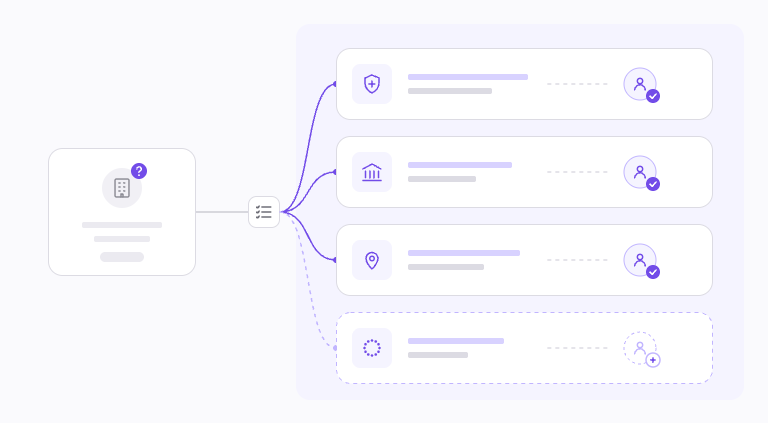
So for most US companies, the useful question isn’t “do we need a DPO?” It’s “which of these roles apply to us, and have we actually named someone for each?” If you also serve customers in the EU or UK, the GDPR’s DPO rules can apply on top.

What is a data protection officer
What a data protection officer does

What a data protection officer does

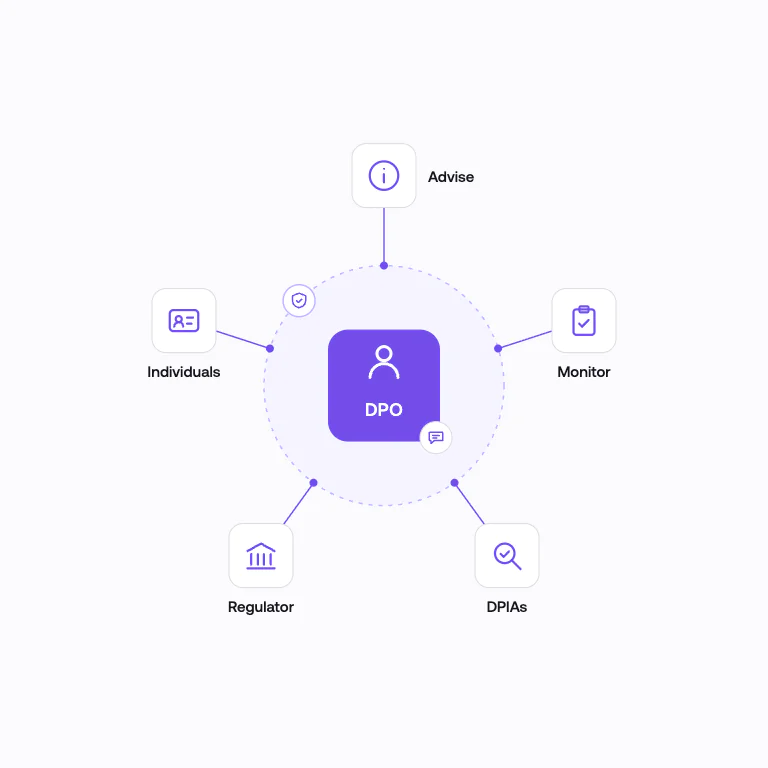
The DPO is a GDPR role. Article 39 gives it five tasks:

  • Informing and advising the organization and its staff about their data protection obligations
  • Monitoring compliance, including training and audits
  • Advising on data protection impact assessments
  • Cooperating with the data protection regulator and acting as its point of contact
  • Acting as the point of contact for individuals about their personal data

Two features set the DPO apart from an ordinary privacy manager. The role is independent: the DPO can’t be told how to do the job, can’t be penalized for doing it, and reports to the highest level of management. And the DPO advises rather than decides. Responsibility for compliance stays with the organization, which is why someone who makes the decisions about how data is processed usually can’t also be the DPO.
Does US law require a data protection officer?

Not in general. As DLA Piper’s global data protection guide puts it, with the exception of entities regulated by HIPAA, there’s no general US requirement to appoint a formal data security officer or data privacy officer. There’s also no federal equivalent of the GDPR’s DPO rules.

That’s the headline, but it’s not the whole answer. Several US laws require you to name a specific person for a specific job. They use different titles, cover different organizations and give that person different duties, which is exactly why they’re easy to miss.

The roles US law does require

Role Law Who it applies to What the person does
Privacy official HIPAA Privacy Rule, 45 CFR 164.530(a)(1) HIPAA covered entities Develops and implements the organization’s privacy policies and procedures
Security official HIPAA Security Rule, 45 CFR 164.308(a)(2) Covered entities and business associates Develops and implements the security policies and procedures
Qualified Individual GLBA Safeguards Rule, 16 CFR 314.4(a) Non-bank financial institutions under FTC jurisdiction Oversees, implements and enforces the information security program
Chief information security officer New York DFS Cybersecurity Regulation Entities regulated by the New York Department of Financial Services Oversees and implements the cybersecurity program
Chief privacy officer or other responsible individual Minnesota Consumer Data Privacy Act Businesses covered by the Minnesota law Has primary responsibility for directing the privacy compliance program, and is named in its documentation
Data protection officer GDPR Article 37 US companies that fall under the GDPR and meet its triggers Advises on and monitors GDPR compliance, independently

HIPAA: a privacy official and a security official

HIPAA is the one US law that clearly requires a named privacy lead. A covered entity must designate a privacy official responsible for developing and implementing its privacy policies and procedures, plus a contact person or office to receive complaints. It must document those designations.

The Security Rule adds a separate requirement to identify a security official, and that one applies to business associates as well as covered entities.

The two roles are different jobs. The privacy official owns how protected health information is used and disclosed and how patients’ rights are handled. The security official owns the administrative, physical and technical safeguards around electronic health information. Smaller organizations often give both roles to one person. That’s allowed, but it means one person carries two sets of obligations.

When a US company needs a GDPR data protection officer

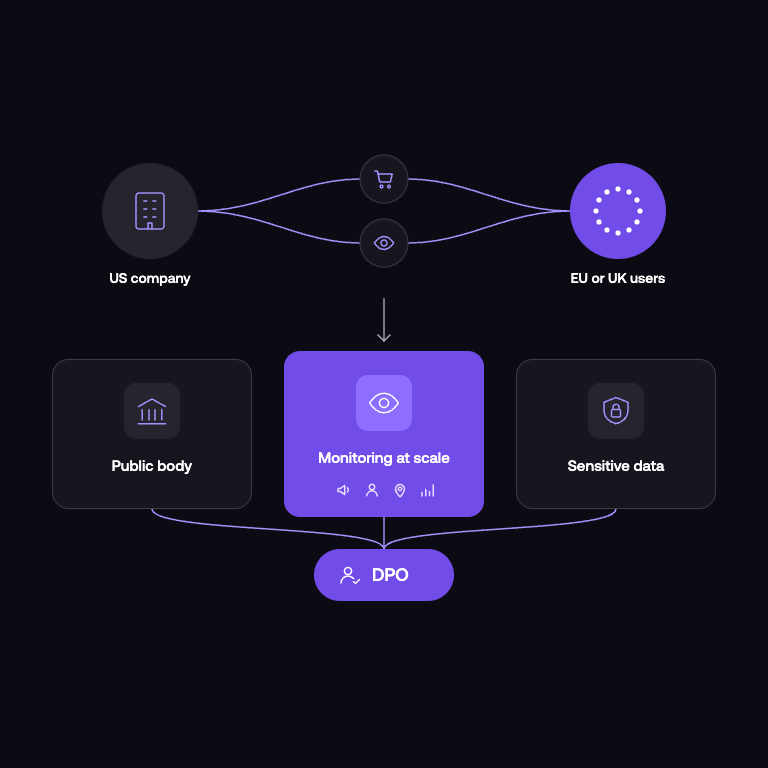
The GDPR reaches beyond Europe. A US company falls under it if it offers goods or services to people in the EU, or monitors their behavior there, even with no European office. The UK GDPR works the same way for people in the UK.

Once you’re in scope, you need a DPO if any of these apply:

  1. You’re a public authority or body.
  2. Your core activities involve regular and systematic monitoring of individuals on a large scale.
  3. Your core activities involve large-scale processing of sensitive data, or data about criminal convictions and offenses.

The second trigger is the one that catches US companies. “Systematic monitoring” includes behavioral advertising, profiling, location tracking and most cross-site analytics. A US adtech, marketing technology or consumer app business with a large European audience can easily meet it.

Two things to keep separate. Headcount isn’t a trigger: a small company doing large-scale behavioral tracking can need a DPO, while a large one that only handles its own payroll may not. And a DPO is a different appointment from the EU representative that non-EU companies may need under Article 27. You might need both.

When a US company needs a GDPR data protection officer

DPO vs privacy officer vs chief privacy officer

The titles overlap in everyday use, but they mean different things.

Data protection officer Privacy officer Chief privacy officer
Legal basis GDPR Articles 37 to 39 HIPAA requires a privacy official for covered entities. Otherwise usually voluntary Named in Minnesota’s law. Otherwise a business leadership role
Independence Required by law Not generally required Not required
Main job Advise and monitor Run the privacy program day to day Set privacy strategy and lead the program
Can they make processing decisions? Usually not, because of the conflict of interest rules Yes Yes

That last row matters if you plan to name one person for everything. A chief privacy officer who sets the company’s data strategy is usually the wrong person to also act as its GDPR DPO, because the DPO’s job is to challenge those decisions independently.

Can these roles be outsourced?

Several of them can, and for smaller organizations it’s often the practical route.

The GDPR explicitly allows a DPO to work under a service contract rather than as an employee. The GLBA Safeguards Rule allows the Qualified Individual to come from a service provider, as long as a senior employee supervises them.

The common thread is accountability. Outsourcing the role doesn’t outsource the responsibility, and it doesn’t work if the outside person has no access to leadership or no real time on your account. The FTC made the point directly when it said an outsourced provider’s board report full of platitudes or upselling wouldn’t meet the rule, and a company would be justified in replacing that provider.

Where these roles go wrong

Three problems come up again and again.

The role exists on paper only

Someone is named in a policy, but they have no time, no budget and no line to leadership. When a regulator asks what that person actually did last year, there’s nothing to show.

The wrong person holds it

The head of IT or marketing is named as privacy lead because they’re closest to the data. For the GDPR DPO role in particular, that’s usually a conflict of interest, because they’d be monitoring their own decisions.

Nobody maps the whole picture

A company that handles health data, offers financing and serves customers in Minnesota and the EU may need four different named roles under four different laws. Each gets appointed separately, by a different team, and nobody checks the gaps between them.

Where Syrenis fits

Where Syrenis fits

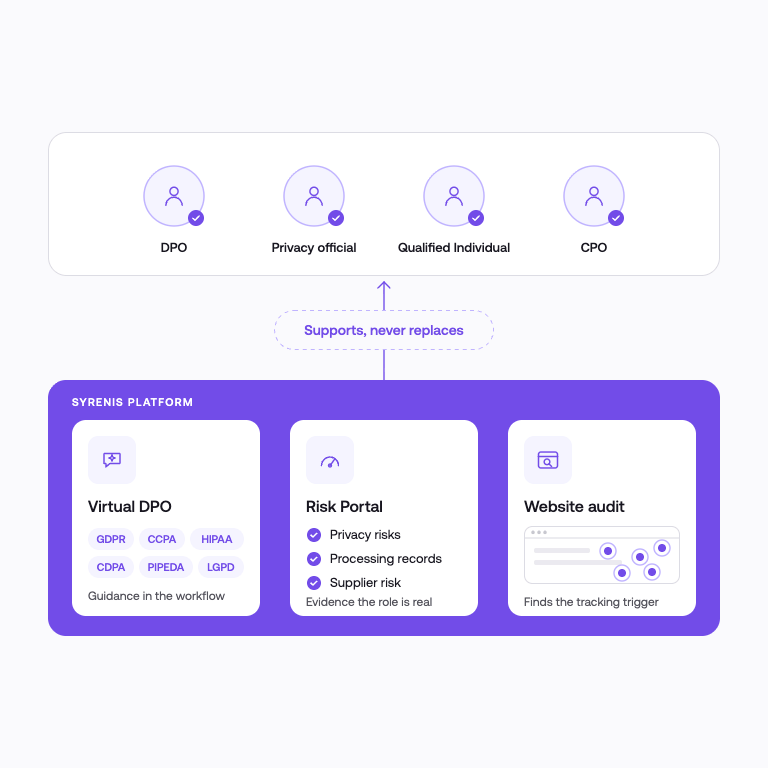
None of these roles can be filled by software. What Syrenis can do is support the people who hold them, with guidance when a decision comes up and a record of what was done.

Virtual DPO is an AI-assisted guidance layer, not a named DPO, so it doesn’t fill a GDPR DPO appointment or any of the US roles above. It puts compliance guidance inside existing workflows, drawn from government and regulatory sources and covering the CCPA, Virginia’s CDPA, HIPAA, the GDPR, PIPEDA and LGPD. The people making day-to-day decisions get an answer when they need it, rather than at the next quarterly review.

The Risk Portal brings privacy risks, processing records and supplier risk into one place, and keeps a record of the reviews and actions taken. That’s the evidence a regulator looks for that a named role is real and not just on paper. The website audit is often how companies discover they meet the GDPR’s monitoring trigger, because behavioral tracking builds up faster than anyone documents it.

For the underlying laws, see our overviews of the CCPA and the GDPR, and how this lands in healthcare and financial services. If you’re looking at this from your own seat, see our pages for legal and compliance teams.

Working out where you stand

List the laws that apply to you: HIPAA if you handle protected health information, the Safeguards Rule if you’re a non-bank financial business, New York’s rules if you’re DFS-regulated, Minnesota’s law if you meet its thresholds, and the GDPR if you serve or track people in Europe.

Then, for each one, write down who holds the role, when they were appointed, and what they did last year. Where the answer is nobody, or nothing, that’s the gap to close first.

If you’d like to see how Virtual DPO and the Risk Portal support the people in these roles, book a demo.

This content is provided for general information only and should not be considered legal advice.

FAQs

What are the duties of a data protection officer?

Under the GDPR, a DPO informs and advises the organization on its data protection obligations, monitors compliance, advises on data protection impact assessments, cooperates with the regulator and acts as the contact point for individuals. The DPO advises rather than decides, and must be able to act independently.

Can anyone be a data protection officer?

Not quite. Under the GDPR, the DPO needs expert knowledge of data protection law and practice, and can’t hold another role that creates a conflict of interest, such as one that decides how personal data is processed. The DPO can be an employee or an outside provider working under a service contract.

What is the qualification of a DPO?

There’s no required certification. The GDPR asks for expert knowledge of data protection law and practice, matched to how complex and sensitive your processing is. In practice, that means documented training and real experience. For the GLBA Qualified Individual, the FTC similarly looks for practical expertise rather than a particular degree or title.

Is it required by HIPAA to have a privacy officer?

Yes. HIPAA requires covered entities to designate a privacy official responsible for their privacy policies and procedures, plus a contact person or office for complaints, and to document those designations. Covered entities and business associates must also identify a security official under the Security Rule.

What is the difference between a HIPAA security officer and a HIPAA privacy officer?

The privacy officer is responsible for how protected health information is used and disclosed, and for patients’ privacy rights. The security officer is responsible for the safeguards that protect electronic health information. They’re separate requirements, though smaller organizations often give both roles to one person.

What does a privacy officer do?

A privacy officer runs an organization’s privacy program day to day: policies, training, handling complaints and requests, and monitoring compliance. Under HIPAA, the role is required for covered entities. Elsewhere in the US it’s usually voluntary, except in Minnesota, where a named chief privacy officer or equivalent must appear in your compliance documentation.

Do US companies need a data protection officer?

Only if they fall under the GDPR and meet one of its triggers, such as large-scale behavioral monitoring of people in Europe. US law has no general DPO requirement, but HIPAA, the GLBA Safeguards Rule, New York’s financial regulations and Minnesota’s privacy law each require a specific named role.

Can a data protection officer be outsourced?

Yes. The GDPR lets a DPO work under a service contract, and the GLBA Safeguards Rule lets the Qualified Individual come from a service provider as long as a senior employee supervises them. In both cases, the organization stays responsible for compliance.

Does Minnesota require a chief privacy officer?

Effectively, yes. Since July 31, 2025, businesses covered by Minnesota’s Consumer Data Privacy Act must document their privacy compliance policies, including the name and contact information of their chief privacy officer or other individual with primary responsibility for those policies.